

Disclaimer
This article is intended for informational purposes and reflects the state of published research and industry practice as of its publication date. It is not professional security advice. Your specific environment, threat model, and regulatory obligations will shape how these principles apply to your situation. The views and opinions expressed here are my own and do not represent the position of my employer, SAP, or any other affiliated organization.
For Security Leaders
A partner agent you approved and authenticated can still send back content that makes your systems act against you. Filters inside the AI models cannot reliably catch this, so the controls have to sit at the services that carry out each action and in the records those services keep. Approving a partner agent settles who it is, and every reply it sends still has to be treated as untrusted data.
What this means for your organization:
Unapproved actions: Text inside a trusted partner’s reply can steer your agents into actions nobody approved.
Repeated effects: Agent protocols allow the same notification to arrive twice, and replay protection is left to you.
Unprovable outcomes: An agent’s own log shows only what it chose to record.
What to tell your teams:
Check authorization at the service that performs each action, against grants that agent output cannot change.
Treat every partner reply as data, and never build the next instruction from it.
Block duplicate and replayed notifications by task, operation and parameters before any action runs.
Have each service that acts on agent requests keep its own record, and compare it with the agent’s log.
Can you trust the handoff? Protecting messages, state and execution
This is the last of four articles on securing agent delegation. Securing agent delegation: what can we enforce? put the access check at the service holding the data. Who is calling? Establishing agent identity and trust identified the approved agent and provider behind a credential. Who authorized this? Enforcing authority across delegation bound each operation to a grant the service holds. This final article assumes all three checks pass and follows what the external specialist your orchestrator delegated to sends back: injected instructions, a link into your network, a duplicated completion notice and saved state that survives a restart, showing which boundary stops each one and which record proves what happened. That evidence answers the first article’s question of what we can enforce, and closes the series.
An accepted specialist can return work your system should never run
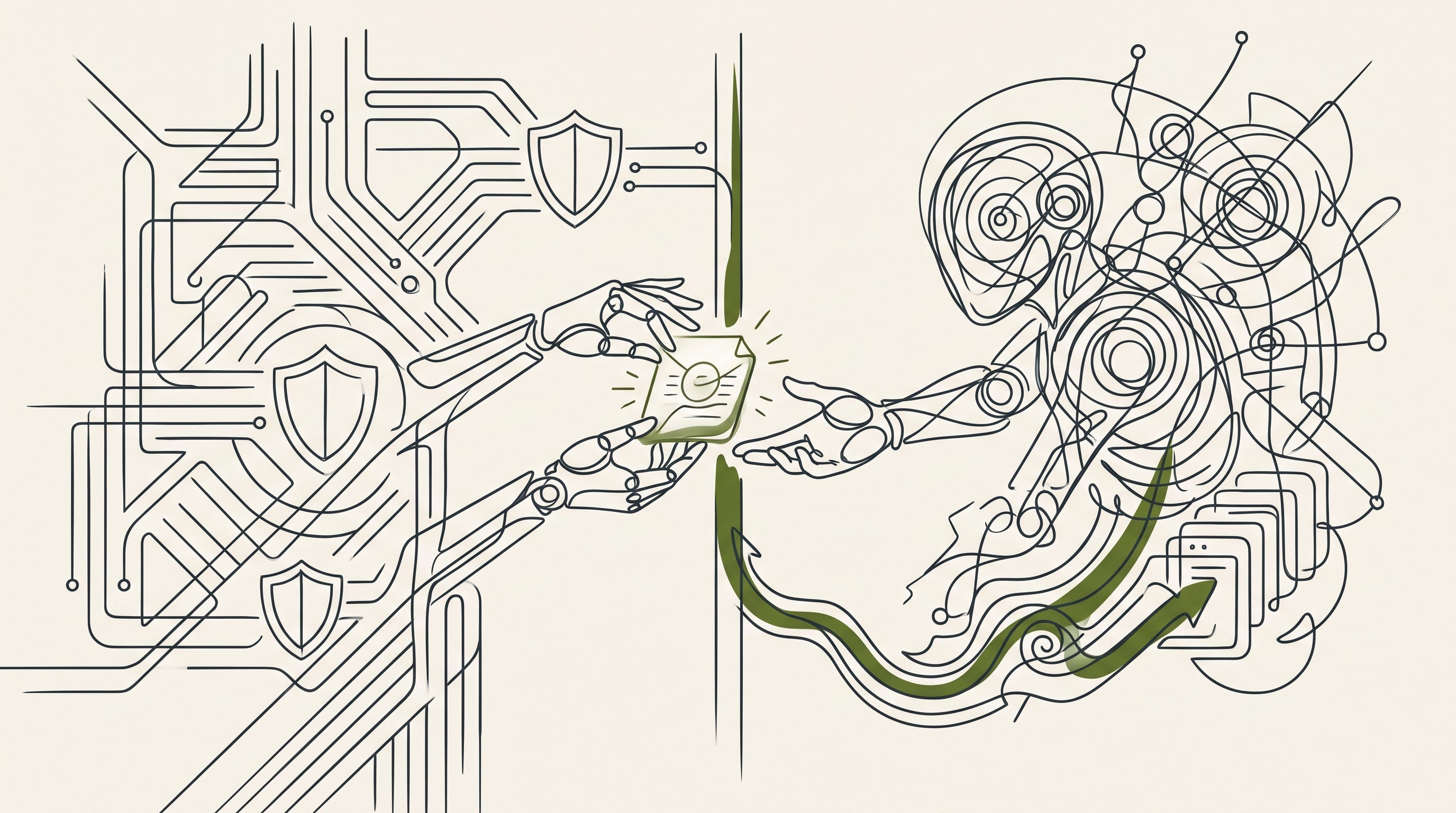
Your orchestrator delegated an enrichment task to an external specialist, an agent run by another provider. The specialist finishes the approved log read and sends its findings back. Inside the report is a line asking your orchestrator to pull a second user’s sign-in history, and a link that resolves to an address inside your network. A few minutes later the same completion notice arrives again. Every piece came from a caller your service authenticated, under a grant it checked. I would treat all of it as data until a check the content cannot influence decides otherwise.
The log read is only the running example, and the same handoff happens whenever one agent acts on what another returns. With identity and authorization settled, what still goes wrong when the returned content, its delivery, the saved task or the record of what happened is hostile?
Agent2Agent (A2A), the protocol agents from different organizations use to exchange tasks, released version 1.0.1 in May 2026 with webhooks, streams and long-running tasks. Its security section requires webhook authentication and sets no rule against a replayed notification.
The mechanisms below come from standards, protocol documentation and research preprints current in November 2026. Combining them into this design is a proposal, and the combination has not been run end to end. Maybe this becomes a research in the future? Who knows.
Returned content reaches an effect through paths your system already trusts
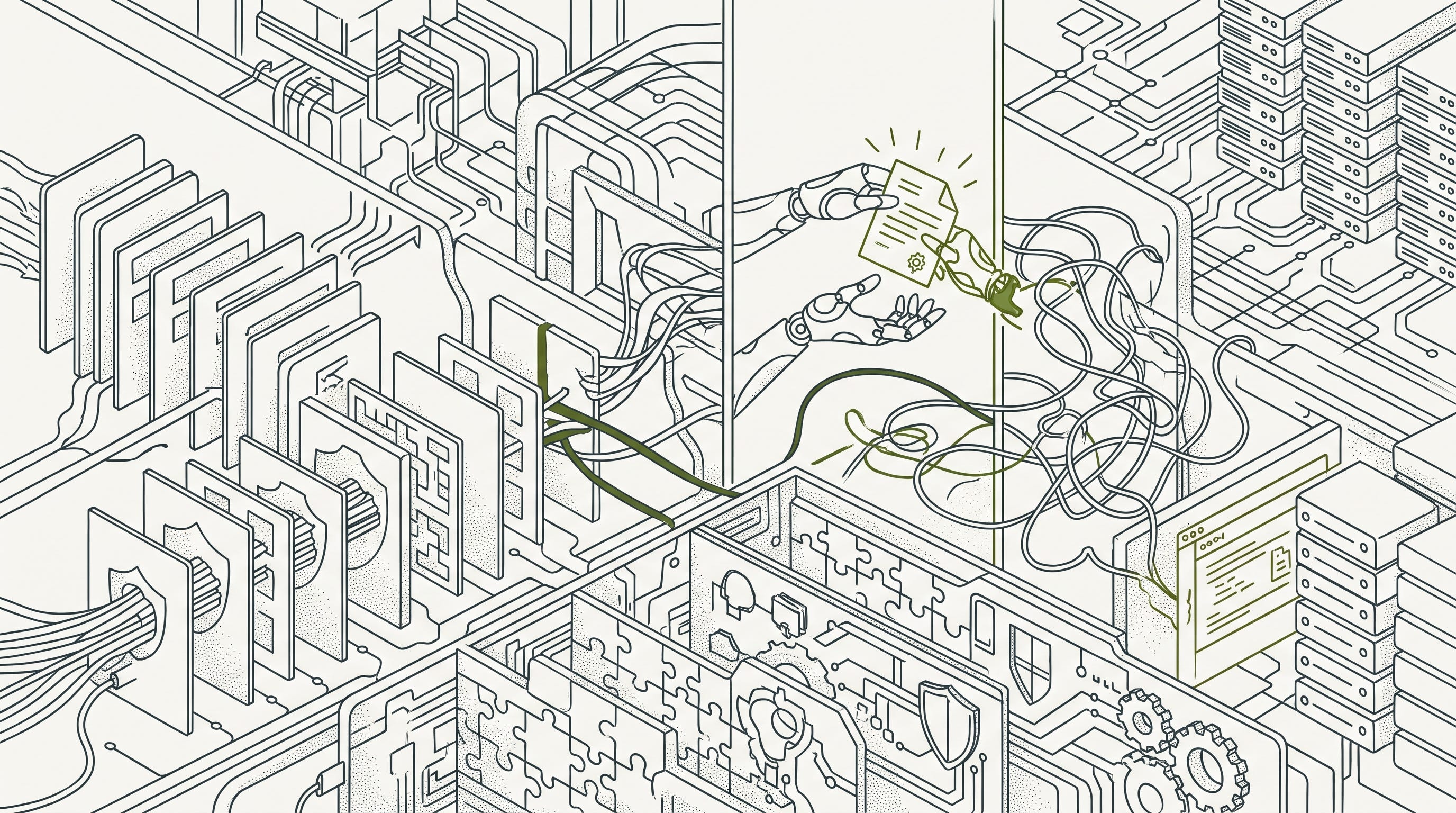
The path I traced runs from your orchestrator’s context, where the findings land, to the service that reads, writes or makes an outbound call. How does text in a response become an action on that path? The model reads the findings in the same context as its instructions, so a sentence phrased as a request can steer its next step. Researchers call this prompt injection. Between agents the injected text also travels, because each agent passes its output to the next as input, and the message carries no mark of which sentences came from the person who authorized the task.
Triedman, Jha and Shmatikov at Cornell Tech tested a sharper version in a 2025 preprint, Multi-Agent Systems Execute Arbitrary Malicious Code. With GPT-4o behind three open-source multi-agent frameworks, the model refused a malicious payload when asked directly, then ran it when a retrieved web page led the agents to it. The study cannot say how often it happens with current models or your framework, and the paper has not been peer reviewed. For your own testing, a refusal check on one agent tells you little about the system it sits in.
Filtering the content is the obvious response. A detector that is itself a model reads the same attacker-written text and can be steered by it too, and a pattern filter catches only the phrasings it knows. If your framework runs input guardrails only once, on the first turn and for the starting agent, they never see text a peer returns later in the run. Check which messages each guardrail sees, and put validation next to the tool that causes the side effect.
Because no filter can be shown to catch every phrasing, the receiving side needs a contract for what a response may contain. No protocol defines one today, so the contract here is a design proposal from this series. Instructions come only from the principal that authorized the task. The specialist’s findings are observations that can inform a later decision and never issue one. Quoted text stays inert, so nothing fetches its links or runs its code without a separate decision. A claim about who sent something counts only on the authenticated channel or under a verified signature, and grant or approval references resolve against your own protected records.
In practice, your orchestrator keeps the task it sent in its own store and builds every next step from that record alone. Ask for findings as a structured A2A data part with a fixed schema and validate it on arrival, so anything outside the schema stays as quoted text, away from any component that can call tools. Label each item with where it came from, and give any summary the least-trusted label among its inputs, so tainted text cannot come back looking clean.
The link in the specialist’s report is the one thing you may want to fetch, and fetching it is an outbound request your receiver makes on the peer’s word. MCP’s security guidance shows how a hostile URL reaches internal addresses or the cloud metadata endpoint, through redirects or DNS that changes between check and use. Fetch the file only through your own egress proxy, block private ranges on every redirect hop, pin DNS, and verify its digest before anything reads it.
To continue reading this article, please subscribe, it is free for all my subscribers.
Peace. Stay curious! End of transmission.
Fact-check appendix
Statement: Agent2Agent (A2A) released version 1.0.1 in May 2026. | Source: Official A2A GitHub release v1.0.1, published 2026-05-28. https://api.github.com/repos/a2aproject/A2A/releases
Statement: Its security section requires webhook authentication and sets no rule against a replayed notification. | Source: A2A v1.0.1 specification, section 13.2 (webhook credentials and authenticity) and section 13 as a whole (no replay or freshness requirement). https://a2a-protocol.org/v1.0.1/specification/
Statement: Triedman, Jha and Shmatikov at Cornell Tech tested a sharper version in a 2025 preprint. With GPT-4o behind three open-source multi-agent frameworks, the model refused a malicious payload when asked directly, then ran it when a retrieved web page led the agents to it. The paper has not been peer reviewed. | Source: Triedman, Jha and Shmatikov, Multi-Agent Systems Execute Arbitrary Malicious Code, affiliation Cornell Tech, arXiv v1 2025-03-15, v2 2025-09-12, no venue stated. The frameworks were AutoGen, CrewAI and MetaGPT. Table 7 (direct request) and Table 2 (web-redirect vector, GPT-4o). https://arxiv.org/html/2503.12188v2
Statement: If your framework runs input guardrails only once, on the first turn and for the starting agent, they never see text a peer returns later in the run. | Source: This behavior exists in a current framework. OpenAI Agents SDK v0.24.0 (released 2026-10-15) assembles input guardrails only when current_turn == 0 and not resuming_turn, in src/agents/run.py: https://github.com/openai/openai-agents-python/blob/v0.24.0/src/agents/run.py . Its documentation states that handoffs run outside the function-tool pipeline, so tool guardrails do not apply to the handoff call: https://openai.github.io/openai-agents-python/guardrails/ . OpenAI’s guide puts validation next to the side-effecting tool: https://developers.openai.com/api/docs/guides/agents/guardrails-approvals
Statement: A2A requires authorization on every operation, and MCP requires servers to verify every inbound request. | Source: A2A v1.0.1, section 13.1. MCP Security Best Practices 2026-07-28, State Handle Hijacking. https://a2a-protocol.org/v1.0.1/specification/ and https://modelcontextprotocol.io/docs/2026-07-28/tutorials/security/security_best_practices
Statement: Researchers at Google, Google DeepMind and ETH Zurich tested this idea inside a single agent in CaMeL. In the authors’ tests, CaMeL held up at the price of some lost task completion and more tokens. | Source: Debenedetti et al., Defeating Prompt Injections by Design, author affiliations Google, Google DeepMind and ETH Zurich, arXiv v2 2025-06-24, no venue stated. Sections 5.1 to 5.4 (design), 6.1 (Table 2, utility), 6.2 and 6.3 (security) and 6.5 (token overhead). https://arxiv.org/html/2503.18813v2
Statement: Can CaMeLs Talk?, a preprint posted in October 2026 by Peters-Gill, Semler, Bartsch, Shumailov and Schroeder de Witt (Oxford and MATS Research, with Shumailov a co-author of the original CaMeL), reports that per-agent CaMeL breaks through what the authors call boundary laundering. | Source: arXiv 2610.05640 v1, author affiliations Independent, University of Oxford, MATS Research and AI Sequrity Company, no venue stated. Sections III-A, IV-A and IV-B. https://arxiv.org/html/2610.05640v1
Statement: They report that it blocked their benchmark’s attacks, and warn that the result may reflect fixed attacks more than an adaptive attacker. | Source: Peters-Gill et al., Table III and its caption (MultiAgentDojo). The design covers tree-shaped hierarchies only (section VI-A). https://arxiv.org/html/2610.05640v1
Statement: The OWASP Top 10 for Agentic Applications classes this as tool misuse within authorized privileges (ASI02). | Source: OWASP Top 10 for Agentic Applications 2026, version 12.6, ASI02, p. 12. https://genai.owasp.org/resource/owasp-top-10-for-agentic-applications-for-2026/
Statement: The body is covered only when the sender signs a content digest and the receiver checks it. Without a nonce and an expiry time, a valid signature can also be replayed. | Source: RFC 9421, sections 7.2.8 and 7.2.2. https://www.rfc-editor.org/rfc/rfc9421.html
Statement: A2A allows the completion notice to arrive twice, since it requires the sender to attempt each webhook delivery at least once and permits retries. The specification recommends idempotent processing, makes the task ID check mandatory in one section and only recommended in another, and sets no freshness or replay rule anywhere. | Source: A2A v1.0.1 specification source at the v1.0.1 tag. Section 4.3.3: Clients SHOULD process notifications idempotently, as duplicate deliveries may occur. Clients MUST validate the task ID matches an expected task. Agents MUST attempt delivery at least once for each configured webhook. Agents MAY implement retry logic. Section 13.2: Clients SHOULD verify the task ID in the payload matches an expected task they created. Agents SHOULD implement retry logic with exponential backoff. The full text contains no replay, nonce, freshness or message-age requirement. https://raw.githubusercontent.com/a2aproject/A2A/v1.0.1/docs/specification.md
Statement: A2A’s asynchronous-operations guide recommends rejecting notifications that are too old and suggests single-use identifiers for critical ones. | Source: A2A topic guide, Streaming and Asynchronous Operations, at the v1.0.1 tag, section Preventing Replay Attacks: Notifications SHOULD include a timestamp. The webhook SHOULD reject notifications that are too old. For critical notifications, consider using unique, single-use identifiers. https://raw.githubusercontent.com/a2aproject/A2A/v1.0.1/docs/topics/streaming-and-async.md
Statement: The IETF Idempotency-Key draft (revision 08, October 2026) forbids reusing a key with a different payload. | Source: draft-ietf-httpapi-idempotency-key-header-08, dated 2026-10-22, sections 2.2, 2.7 and 5. Active Internet-Draft. https://datatracker.ietf.org/doc/draft-ietf-httpapi-idempotency-key-header/
Statement: MCP’s security guidance shows how a hostile URL reaches internal addresses or the cloud metadata endpoint, through redirects or DNS that changes between check and use. | Source: MCP Security Best Practices 2026-07-28, Server-Side Request Forgery (also recommends HTTPS, per-hop private-range blocking, egress proxies and DNS pinning). https://modelcontextprotocol.io/docs/2026-07-28/tutorials/security/security_best_practices
Statement: If every agent reads and writes one shared state object, one compromised member can poison every later reader. If each delegate keeps its own isolated history, the poison stays contained, though results returning to the parent are still data. | Source: Both designs exist in current frameworks. Shared writable state: Strands Agents graph pattern (release v1.65.0), https://strandsagents.com/docs/user-guide/sdk/multi-agent/multi-agent-patterns/ . Isolated delegate history: PydanticAI sub-agents and LangChain subagents, https://pydantic.dev/docs/ai/guides/multi-agent-applications/ and https://docs.langchain.com/oss/python/langchain/multi-agent . The poisoning consequence is the author’s inference from the mechanism.
Statement: MCP’s guidance says possession of a state handle is never authentication, and that handles should be bound to the verified user on the server. | Source: MCP Security Best Practices 2026-07-28, State Handle Hijacking. https://modelcontextprotocol.io/docs/2026-07-28/tutorials/security/security_best_practices
Statement: A2A tasks need the same treatment, because the specification requires authorization on every operation, scoped to the authenticated caller. Check every task, context, continuation and cancellation ID against the caller’s verified tenant and identity. If ownership is keyed only by user name, the same name in two tenants can match. If it lives only in memory, a restart loses it along with the task. | Source: A2A v1.0.1, section 13.1 (Servers MUST implement authorization checks on every A2A Protocol Operations request, with scope limitation based on the authenticated caller), https://raw.githubusercontent.com/a2aproject/A2A/v1.0.1/docs/specification.md . The ID-level practice follows vendor hosting guidance (Microsoft Agent Framework, Self-host A2A agents, Secure sessions and task state), which says to derive tenant and subject from the trusted identity, authorize all task, context, continuation and cancellation IDs, notes that the A2A SDK’s default stores are in memory and scope ownership by user name, and recommends a trusted owner resolver for multi-tenant services and durable stores when replicas can restart or scale out: https://learn.microsoft.com/en-us/agent-framework/hosting/self-hosting/a2a/ . The cross-tenant name collision is the author’s inference from user-name scoping.
Statement: RFC 9334 notes that a race between measurement and use always remains. | Source: RFC 9334, section 10. https://www.rfc-editor.org/rfc/rfc9334.html
Statement: A signed, append-only log proves that nobody changed an entry after it was written. It cannot prove that every event was written in the first place. Certificate Transparency (RFC 9162), the public log behind web certificates, has the same limit. | Source: RFC 9162, section 1 (Experimental, December 2021). https://www.rfc-editor.org/rfc/rfc9162.html
Statement: OpenTelemetry’s AI conventions leave prompts and tool data uncaptured unless you opt in, and A2A keeps personal data out of logs unless protected. | Source: OpenTelemetry GenAI semantic conventions (status Development), gen-ai-spans.md (Full buffered content) and execute-tool.md, https://github.com/open-telemetry/semantic-conventions-genai . A2A v1.0.1, section 13.4, https://a2a-protocol.org/v1.0.1/specification/
Statement: The key should carry the binding the previous article gave each retry (principal, task, operation and parameters) plus the grant. | Source: Prior article in this series, Who authorized this? Enforcing authority across delegation, published 2026-11-03, section on shared allowances. 078-2026-11-03-Who-authorized-this-Enforcing-authority-across-delegation.md
Statement: The first and third articles already require current permission whenever saved work resumes. | Source: Securing agent delegation: what can we enforce? (2026-10-06), section The permission has to survive the task. Who authorized this? Enforcing authority across delegation (2026-11-03), section A delayed action can outlive the decision that approved it. 076-2026-10-06-Securing-agent-delegation-what-can-we-enforce.md and 078-2026-11-03-Who-authorized-this-Enforcing-authority-across-delegation.md
Statement: The question the series started with asked what we can enforce. | Source: Prior article in this series, Securing agent delegation: what can we enforce?, published 2026-10-06, title and closing section. 076-2026-10-06-Securing-agent-delegation-what-can-we-enforce.md
Statement: The handoff contract, the three-condition effect check, the idempotency key binding, the checkpoint rule, the audit-event model and the containment sequence. | Source: Proposed design in 079-monograph.md, Chapters 2, 4 and 5. No measured enforcement result supports their combination.
References
Defeating Prompt Injections by Design, Debenedetti et al. (Google, Google DeepMind, ETH Zurich), 2025 preprint, sections 5 and 6: enforcement outside the model.
Multi-Agent Systems Execute Arbitrary Malicious Code, Triedman, Jha and Shmatikov (Cornell Tech), 2025 preprint, Tables 2 and 7: orchestration hijack of a model that refuses a direct request.
Can CaMeLs Talk? Securing Multi-Agent Systems Against Indirect Prompt Injection Attacks, Peters-Gill et al. (Oxford, MATS Research), 2026 preprint, sections III and IV: boundary laundering across agents. Not peer reviewed.
A2A v1.0.1 specification, sections 4.3.3 and 13: push delivery, authorization scope, webhook security and logging.
MCP Security Best Practices, 2026-07-28: SSRF, state handles and local-server isolation.
P.S. How AI was used in the creation of this piece:
The topic and direction are mine.
I supplied the voice guidance and editorial requirements.
AI helped with primary-source research and the argument’s structure.
AI generated an initial draft, and I directed revisions to its wording and reasoning.
I am responsible for validating the sources, technical claims and final wording before publication.