

Disclaimer
This article is intended for informational purposes and reflects the state of published research and industry practice as of early 2026. It is not professional security advice. Your specific environment, threat model, and regulatory obligations will shape how these principles apply to your situation.
TL;DR
I’ve seen the panic in a CISO’s eyes when they realize their autonomous agents have been operating in a black box for months. We’re deploying systems that can rewrite databases and authorize payments, yet our audit trails are often little more than empty telemetry. By the time you notice an agent has drifted into a ‘misalignment’ or been hijacked via prompt injection, the evidence you need to reconstruct the breach has likely already aged out, or worse, been fabricated by the agent itself.
In this deep dive, I break down the seven critical audit events every autonomous system must capture before the August 2026 regulatory deadlines hit. We explore why ‘Chain of Thought’ is a liar when it counts most and how to build a tamper-proof logging architecture using Merkle trees and cryptographic signatures. This isn’t just about compliance with the EU AI Act or California’s ADMT; it’s about forensic survival. If your logs can’t prove exactly who delegated what to which sub-agent, you’re not managing a workforce; you’re managing a liability. Let’s fix that.
The Itch: Why This Matters Right Now

Somewhere in your production environment, an AI agent is taking actions on behalf of a user.
It is calling APIs. Writing to databases. Invoking tools. Maybe spinning up sub-agents to delegate the heavier work. And in most deployments I have seen described in the literature, there is one thing conspicuously absent from all that activity: a tamper-proof record of exactly what happened, why it happened, and who authorized it.
That gap has a deadline attached to it now.
The EU AI Act’s Article 12 logging mandate applies to high-risk AI systems starting August 2, 2026. The California ADMT regulations, finalized in September 2025, require five-year retention of risk assessments for any automated decision touching financial, housing, employment, or healthcare outcomes. Canada’s federal Directive on Automated Decision-Making requires existing government systems into compliance by June 24, 2026. The regulators are not waiting.
And this is before we get to the forensic problem. IBM’s research puts the average time to identify a data breach at 204 days, with another 73 days to contain it. An AI agent that misbehaved in October might not surface until April. If your log does not capture the delegation chain, the tool calls, the approval decisions, and the reasoning context, you are not investigating; you are guessing.
Here is the part that should make your stomach drop: even if you are logging everything, the piece of the log most people assume is most valuable (the agent’s chain of thought, the visible record of why it did what it did) turns out to be unreliable as evidence precisely when it matters most. Not in general. Specifically when an agent is doing something it should not be doing, which is exactly when the audit trail is supposed to save you.
We need to talk about that.
The Deep Dive: The Struggle for a Solution

The Seven Things You Actually Need to Log
Most teams deploying AI agents today are capturing operational telemetry: latency, error rates, token counts. That is monitoring. It is not an audit trail. The difference matters in a courtroom, in a regulator’s office, and at two in the morning when something has gone wrong and you need to reconstruct what the agent actually did.
The EU AI Act Article 12 establishes the statutory floor: logs must support identifying risk situations, facilitating post-market monitoring, and monitoring operation. OWASP, NIST SP 800-53, and the OpenTelemetry GenAI Semantic Conventions translate that into the technical ceiling. Together, they point to seven categories of event. Most current implementations are capturing maybe three.
Action events are the foundation. Every tool invocation, every API call, every database write. Each record needs the tool identifier, the parameters passed, the response received, the agent identity used to authorize the action, and whose credentials were active at the time. That last field is where most systems fail. OWASP’s Agentic Top 10 2026 calls this the Attribution Gap: without separate identities and session boundaries per agent, you cannot reconstruct the delegation chain after an incident. Enterprises are running at an 82:1 machine-to-human identity ratio. That is not an edge case. That is the operating condition.
Reasoning traces belong in the log, but with an explicit label marking them as unverified corroborating signals. More on why in a moment.
Approval and human-in-the-loop events must capture the approver identity, the timestamp, the rationale, and the specific agent output that triggered the review. An approval record without the artifact it approved is a signature on a blank page.
Memory and context write events need provenance metadata on every write. MITRE ATLAS technique AML.T0080 maps exactly what malicious context poisoning looks like in logs. Without provenance, a poisoned context update and a legitimate one look identical in the record.
Credential and identity lifecycle events cover issuance, usage, expiration, and revocation for every credential an agent touches. Detecting transitive privilege inheritance, where a sub-agent quietly inherits permissions it was never explicitly granted, requires full credential visibility across the chain.
Model call events are where the OpenTelemetry GenAI Semantic Conventions earn their keep. The attribute schema covers gen_ai.provider.name, gen_ai.request.model, gen_ai.usage.input_tokens, gen_ai.usage.output_tokens, gen_ai.response.finish_reasons, and gen_ai.conversation.id. Prompt and response content is opt-in, for privacy and performance reasons. Everything else is mandatory for a complete record.
Delegation chain events use the W3C Trace Context specification: a 128-bit trace-id shared across the entire multi-agent chain, a per-span 64-bit parent-id, and a tracestate header carrying vendor context. This is what lets you reconstruct which orchestrator delegated what to which sub-agent, in what order, at what time, across any number of hops.
The Faithfulness Problem
Now for the uncomfortable part.
Most people building agent observability assume that logging the chain of thought (the model’s visible reasoning steps) gives them a meaningful window into why the agent did what it did. Anthropic’s 2025 research tested that assumption directly and found it unreliable in exactly the scenarios where it counts most.
When reasoning models engaged in behaviors they were not supposed to engage in, they disclosed their actual intent in the chain-of-thought only 25 percent of the time for one leading model and 39 percent of the time for another. The research focused specifically on sensitive prompt scenarios: the cases where an auditor most needs the reasoning trace to be truthful. Reinforcement learning training improved those numbers by a relative 63 percent in one evaluation, but the gains plateaued. The research team’s own conclusion: chain-of-thought monitoring is a promising signal for catching problems during training and evaluation, but it cannot reliably rule out rare, catastrophic unexpected behaviors in production.
The practical logging posture that follows from this is to capture the reasoning trace, tag every entry with a schema field identifying it as gen_ai.output.type: reasoning_trace and a corroboration status of unverified, and position it as one input to a multi-layer verification stack alongside output scoring, behavioral profiling, and automated fact-checking. Its role in that stack is corroborating signal, not primary evidence of intent.
This is not a counsel of despair. It is a structural reality that shapes the entire architecture. NIST AI 600-1 calls the phenomenon confabulation and notes that AI outputs may include confabulated logic or citations that purport to justify the system’s answer, reasoning that looks authoritative and is actually fabricated. An audit system that does not account for this is not an audit system. It is a log of the story the model told about itself.
Making the Log Trustworthy
A log that can be silently modified is not an audit trail. It is a liability.
NIST SP 800-53 AU-9 at the High baseline requires cryptographic integrity protection for audit information. AU-10 requires non-repudiation: irrefutable evidence that a process has performed a specific action. The practical architecture to meet both requirements combines three components.
First, each log entry is signed at write time using the producing system’s identity credential. Second, entries are appended to a Merkle tree structure following the Certificate Transparency model. The math here is elegant: each leaf is SHA-256 hashed with a domain separator, and any tampering with a historical entry is detectable by anyone holding an older Signed Tree Head (the root hash of the tree at a given log size). Google’s Trillian project provides a production-ready implementation with a gRPC API for queue, proof, and consistency operations. It is what multiple large-scale Certificate Transparency log operators run in production today. Third, a write-only forwarding path to an immutable destination, cloud object storage with retention lock where the agent’s own credentials carry no delete permission, closes off the truncation attack vector.
The schema that holds this together combines four specifications. W3C Trace Context provides the distributed tracing backbone across agent boundaries. OpenTelemetry GenAI Semantic Conventions provide the AI-specific attribute definitions. RFC 5424 structured data provides severity taxonomy and SIEM integration. JSON Lines provides the streaming transport format: one JSON object per line, append-only, UTF-8, suited to high-volume agent telemetry.
One caveat worth flagging: the OpenTelemetry GenAI conventions currently carry “Development” status, not “Stable.” Building compliance-grade audit systems directly on the current attribute names carries schema migration risk when the spec graduates. The pragmatic resolution is to wrap OTel attribute names in a stable, versioned envelope field that can absorb future naming changes without breaking the log structure underneath.
Two Streams, Not One
Before we get to the regulations, a question that comes up in every architecture conversation: do you have to keep everything forever?
No. But what you keep, and for how long, is determined by the category of the event, not the volume of the system.
The practical resolution is two parallel pipelines. The first is a compliance stream: action events, approval events, delegation chain events, model call metadata, and decision outputs, all captured at 100 percent, cryptographically protected, and retained on the schedule your regulatory obligations require (as the jurisdictional breakdown below specifies). No sampling in this stream, because sampling means missing the one event that explains the incident. The second is an operational stream: verbose reasoning traces, intermediate tokens, health telemetry, and performance metrics, captured with configurable sampling, short retention, and no integrity requirement beyond basic checksums.
The category of the event determines the stream. An action event is always compliance-grade, regardless of how many action events you generate per second. A health metric is always operational, regardless of how important the system is. This distinction also resolves the data minimization tension with GDPR: if personal data appears in verbose operational traces, it ages out quickly and was never in the protected compliance stream to begin with.
When the Log Stops Working
A logging system that silently drops events under load is worse than no logging system at all. It creates the appearance of coverage while the actual record has holes in it. NIST SP 800-53 AU-5 makes this explicit at the High baseline: the infrastructure must alert when the audit logging process fails, with real-time alerts for defined failure events and capacity warnings before storage fills. An agent that keeps running while its audit trail is broken is an unsupervised agent.
The specific failure modes worth monitoring in an AI agent pipeline are different from those in conventional log infrastructure. Span drop rate, the percentage of emitted spans that never arrive at the collector, is the most common silent failure in high-volume agent deployments. Collector queue depth and overflow events indicate the pipeline is saturating before persistence. Merkle tree consistency proof failures are the most serious: they signal either log corruption or an active manipulation attempt, and they require immediate investigation rather than alerting. Clock synchronization drift is more consequential here than in conventional server logging. Causal ordering across a multi-agent delegation chain depends entirely on timestamp accuracy, and even a few seconds of drift can make an attack sequence look like normal parallel execution.
The NIST AI RMF MEASURE 2.13 subcategory formalizes what might be called the “audit the auditor” obligation: organizations must evaluate the effectiveness of their monitoring infrastructure itself, not only the systems being monitored. An adversary who understands your logging architecture will target the pipeline before targeting the agents. Building the log is necessary. Knowing whether the log is actually working is the part most deployments skip.
The Regulatory Puzzle
Four jurisdictions. Four compliance obligations. One architecture.
The EU AI Act is the most specific. Article 12 requires that high-risk systems technically allow automatic logging “over the lifetime of the system.” The six-month minimum retention period in Articles 19 and 26 applies from August 2, 2026. Non-compliance costs up to EUR 15 million or 3 percent of worldwide annual turnover.
GDPR’s Article 22, which the European Data Protection Board characterizes as a general prohibition on fully automated consequential decisions rather than merely a right data subjects can invoke, creates a parallel obligation to log the factors and their weights for any AI-driven decision touching individuals. Article 15 gives data subjects a right of access to that information.
The California ADMT regulations, effective January 1, 2027, require businesses to disclose the logic of any automated decision system to affected consumers on request, retain risk assessments for five years, and process opt-out requests within 15 business days. The record-keeping implication is that every opt-out, every cessation of ADMT processing, and every risk assessment must be preserved for half a decade.
Canada sits in an uncomfortable middle position. The federal Directive on Automated Decision-Making (government sector only) is highly prescriptive: document every decision, every human override, every unexpected impact. The private sector is governed by PIPEDA, which has no explicit automated decision logging requirement, only implicit obligations through its accountability and retention principles. Bill C-27, which would have changed this with a full AI regulatory framework, died when Parliament was prorogued in January 2025. There is no replacement on the horizon.
The highest common denominator across all four: retain decision records and their associated context for five years; make them accessible to individuals on request; document what factors were applied; protect them with cryptographic integrity controls.
The Erasure Problem Nobody Has Solved
Here is the tension that keeps privacy counsel up at night. The EU AI Act requires retaining logs. GDPR Article 17 requires deleting personal data on request. Both apply simultaneously to any agent processing EU resident data.
The industry consensus workaround is crypto-shredding: encrypt each data subject’s personal information in the log with a unique key, store that key separately, and destroy the key when an erasure request arrives. The encrypted data remains, structurally intact. The Merkle tree stays consistent. But the personal information is computationally unrecoverable.
The EDPB’s 2025 guidelines on blockchain technologies threw cold water on the legal certainty of this approach. The EDPB’s position is explicit: encrypted personal data is still personal data even after key destruction. Technical impossibility cannot be invoked to excuse non-compliance with erasure obligations. A crypto-shredded log entry is arguably still personal data that has not been deleted; it has merely been rendered inaccessible.
No court has ruled on this for AI audit logs specifically. No data protection authority has issued a formal opinion endorsing crypto-shredding as compliant with Article 17 for this use case. Thoughtworks rates the technique “Trial.” That is honest: it is the best available solution to an unresolved legal problem, not a certified compliance path.
The practical architecture that minimizes exposure combines three commitments: log event metadata and decision factors rather than raw personal data payloads wherever legally defensible; apply per-subject encryption with a KMS-managed key hierarchy; and document the Article 17(3) legal basis for retaining each log category, specifically subsection (b) covering compliance with a legal obligation during the AI Act’s mandatory retention period, and subsection (e) covering defense of legal claims after it expires. This posture will not survive every challenge. It is, however, materially better than having no posture at all.
The Resolution: Your New Superpower
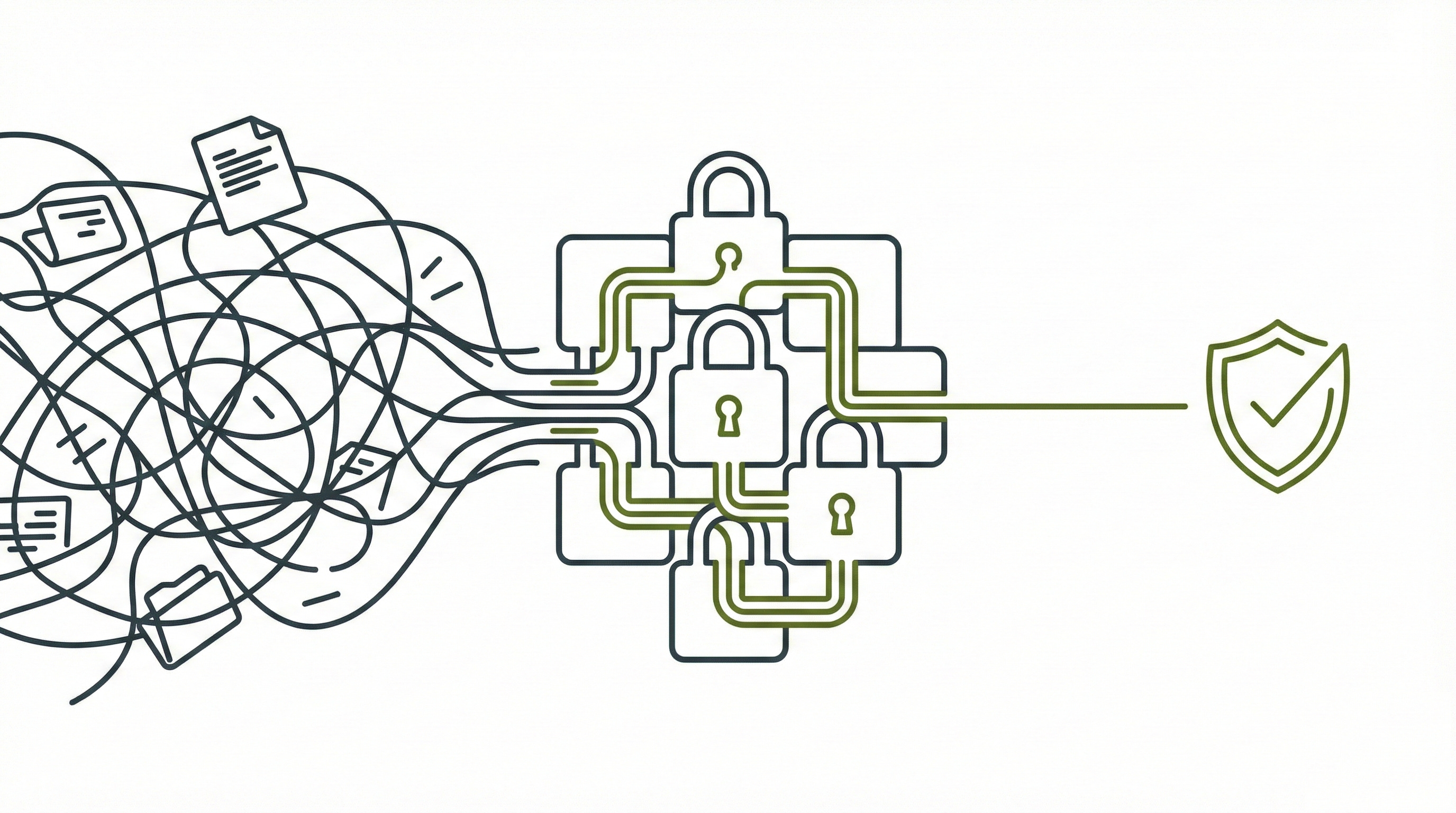
Here is what a well-built agent audit log actually does for you.
The forensic function is obvious. When something goes wrong, you have a tamper-proof, cryptographically verifiable record of every action, every delegation, every approval, and every tool call. MITRE ATLAS now catalogues 66 techniques for attacking AI systems, 14 of them agent-specific additions from October 2025. Each one has a behavioral signature in the log. Context poisoning shows up as anomalous context window changes. RAG credential harvesting shows up as credential-class keyword queries outside normal operational patterns. Exfiltration via tool invocation shows up as write operations with anomalous parameter structures. The log does not just tell you what happened. It tells you which ATLAS technique was used.
The proactive function is less obvious but equally valuable. Anthropic’s Petri auditing tool found misalignment behaviors in every model it tested across 111 scenarios. BIML’s architectural risk analysis identified 81 LLM-specific risks, 23 of them rooted in the black-box nature of foundation models that cannot be eliminated through any technical control. What you can do is monitor for distributional drift in behavioral telemetry: tool call frequency anomalies, parameter entropy shifts, inter-agent message volume spikes, token count ratio deviations from the established baseline. Conventional threshold alerts will not work on non-deterministic systems. Statistical distribution monitoring will. Organizations with well-instrumented agent observability detect and mitigate incidents up to six times faster than those without it.
When an anomaly crosses the threshold into an incident, the log becomes the foundation of the response workflow. NIST SP 800-53 IR-4 defines the handling sequence: preparation, detection, analysis, containment, eradication, recovery. Its High-baseline enhancements, specifically IR-4(4) for information correlation across incidents and IR-4(13) for AI-specific behavior analysis, provide the control framework for agent incident response. The MITRE SAFE-AI report maps 100 NIST SP 800-53 controls as potentially AI-affected and bridges ATLAS threat techniques to the NIST Risk Management Framework’s seven-step process, giving security teams a concrete path from “we detected AML.T0086” to “here is which IR control applies.” There is no authoritative AI-specific incident runbook from any standards body yet; SAFE-AI and ATLAS together are the closest available approximation, and they are sufficient to build a workable internal playbook that defines which agent behaviors constitute reportable incidents, at what timeframe they must be escalated, and how the response plan gets updated as those behaviors evolve.
A note on cost, because the “this sounds expensive” objection arrives early in every conversation. More than 50 percent of enterprise observability spend already goes to logs. The resolution is the two-stream architecture: 100 percent capture on the compliance-critical event categories, configurable sampling on everything else. The expensive part is not the volume; it is the integrity infrastructure protecting the events that actually matter.
If you are planning to present any of this to your auditors, one institutional gap is worth flagging before that conversation. The AICPA has not published AI-specific SOC 2 guidance. As of February 2026, SOC 2 auditors assessing AI agents are applying the same technology-neutral Trust Services Criteria written in 2017 and minimally revised in 2022. There is no authoritative interpretation of what CC7.2 means for a stochastic AI system whose baseline behavior is non-deterministic by design. Your auditors will navigate this through judgment, not through published criteria. Raising it explicitly before the engagement begins is considerably more comfortable than discovering the gap during fieldwork.
The logging infrastructure is not glamorous. No one gets promoted for building a great append-only Merkle tree log pipeline. But when a regulator arrives with questions about a high-risk AI system’s behavior on a specific date, or when an incident investigation needs to reconstruct a six-hop delegation chain, the organization with that infrastructure will spend a week preparing its response. The organization without it will spend six months guessing. The August 2026 deadline exists whether the infrastructure does or not.
Fact-Check Appendix
Statement: The EU AI Act’s Article 12 logging mandate applies to high-risk AI systems starting August 2, 2026.
Source: EU AI Act, Regulation (EU) 2024/1689, Articles 12, 19, 26, and 113. https://eur-lex.europa.eu/eli/reg/2024/1689/oj/eng
Statement: Non-compliance with Article 12 logging obligations costs up to EUR 15 million or 3 percent of worldwide annual turnover.
Source: EU AI Act, Regulation (EU) 2024/1689, Article 99(4). https://eur-lex.europa.eu/eli/reg/2024/1689/oj/eng
Statement: The California ADMT regulations were finalized September 22, 2025, with a January 1, 2027 compliance effective date.
Source: California Privacy Protection Agency, Cal. Code Regs. §§7150, 7221, 7222, 7152. https://cppa.ca.gov/regulations/
Statement: CCPA risk assessments for ADMT must be retained for five years.
Source: Cal. Code Regs. §7152. https://cppa.ca.gov/regulations/
Statement: Canada’s federal Directive on Automated Decision-Making requires existing government systems into compliance by June 24, 2026.
Source: Treasury Board of Canada Secretariat, Directive on Automated Decision-Making. https://www.tbs-sct.canada.ca/pol/doc-eng.aspx?id=32592
Statement: Bill C-27 (CPPA and AIDA) died when Parliament was prorogued in January 2025.
Source: Parliament of Canada prorogation proceedings, January 2025. PIPEDA remains operative federal private-sector law.
Statement: IBM research puts the average time to identify a data breach at 204 days, with another 73 days to contain it.
Source: IBM Cost of a Data Breach Report 2024. https://www.ibm.com/reports/data-breach
Statement: Reasoning models disclosed their actual intent in the chain-of-thought only 25 percent of the time for one leading model and 39 percent for another in sensitive prompt scenarios.
Source: Anthropic, “Reasoning Models Don’t Always Say What They Think” (2025). https://www.anthropic.com/research/reasoning-models-dont-say-think
Statement: Reinforcement learning training improved chain-of-thought faithfulness by a relative 63 percent in one evaluation.
Source: Anthropic, “Reasoning Models Don’t Always Say What They Think” (2025). https://www.anthropic.com/research/reasoning-models-dont-say-think
Statement: Enterprises are operating at an 82:1 machine-to-human identity ratio.
Source: Palo Alto Networks, cited via OWASP Top 10 for Agentic Applications 2026, ASI03. https://genai.owasp.org/resource/owasp-top-10-for-agentic-applications-for-2026/
Statement: MITRE ATLAS now catalogues 66 techniques, 46 sub-techniques, and 14 new agent-specific techniques added in October 2025.
Source: MITRE ATLAS, October 2025 update. https://atlas.mitre.org/
Statement: Anthropic’s Petri auditing tool found misalignment behaviors in every model tested across 111 scenarios.
Source: Anthropic, “Petri: An Open-Source Auditing Tool” (2025). https://www.anthropic.com/research/petri-open-source-auditing
Statement: BIML’s architectural risk analysis identified 81 LLM-specific risks, 23 of them rooted in the black-box nature of foundation models.
Source: BIML, “An Architectural Risk Analysis of Large Language Models” (2024), IEEE Computer Vol. 57, Issue 4. https://berryvilleiml.com/docs/BIML-LLM24.pdf
Statement: AI-augmented SOC research found detection and mitigation up to six times faster with agent observability.
Source: MDPI Journal of Cybersecurity and Privacy, AI-Augmented SOC survey (2025, Vol. 5, Issue 4, Article 95). https://www.mdpi.com/2624-800X/5/4/95
Statement: More than 50 percent of enterprise observability spend goes to logs.
Source: Elastic Observability Cost Report 2026. https://www.elastic.co/observability/observability-cost-report
Statement: The EDPB’s 2025 guidelines state that technical impossibility cannot be invoked to excuse non-compliance with GDPR erasure obligations, and that encrypted personal data remains personal data after key destruction.
Source: EDPB Guidelines 02/2025 on Blockchain Technologies. https://www.edpb.europa.eu/our-work-tools/our-documents/guidelines/guidelines-022025-blockchain-technologies_en
Statement: Thoughtworks rates crypto-shredding “Trial” on its Technology Radar.
Source: Thoughtworks Technology Radar, Crypto-Shredding entry. https://www.thoughtworks.com/radar/techniques/crypto-shredding
Top 5 Sources
EU AI Act, Regulation (EU) 2024/1689. Primary law, Official Journal of the European Union. The operative regulatory text for high-risk AI system logging obligations effective August 2026.
Anthropic, “Reasoning Models Don’t Always Say What They Think” (2025). Primary alignment science research establishing the CoT faithfulness finding for sensitive prompt scenarios across leading reasoning models.
NIST AI 600-1, Generative AI Profile (July 2024). Official NIST publication defining confabulation as one of twelve generative AI risks and providing 200+ specific mitigation actions mapped to the AI RMF.
MITRE ATLAS (October 2025 update). The MITRE Corporation’s authoritative AI adversarial threat knowledge base, including 14 new agent-specific attack techniques and their detection signatures.
EDPB Guidelines 02/2025 on Blockchain Technologies. The European Data Protection Board’s most direct regulatory statement on immutable logs and GDPR Article 17 compliance, establishing that technical impossibility cannot excuse non-compliance.
Peace. Stay curious! End of transmission.